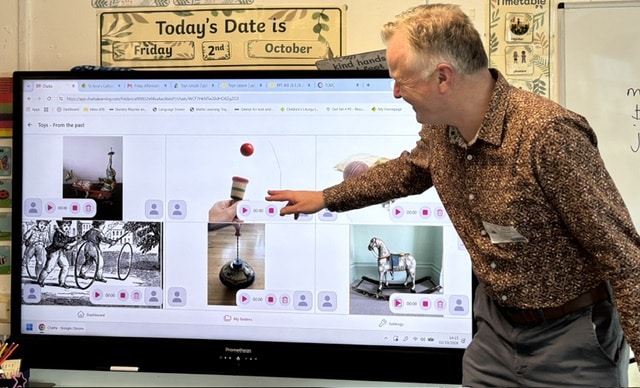
Chatta makes a difference because it gives every child in the room live, supported access to the connected language that classroom learning depends on, including children whose difficulties nobody has identified. That is why school leaders report that it works in mainstream classrooms, from nursery to Key Stage 5, as everyday teaching rather than a separate intervention. This summary explains how it works, and why it matters developmentally.
What Chatta is
Chatta is a whole-class teaching approach built on live modelling and audio-visual scaffolding.
The teacher models the thinking and the language live, in front of the class, with visual cues and spoken prompts that every child can see and hear at the moment they need them. Activities are quick, varied and gradually more challenging, and the lesson moves often between modelling, talking together and thinking independently.
Three things make it different in practice:
- It is delivered to the whole class, so no child has to be identified or withdrawn to get support.
- The scaffold is in the moment, not before or after the lesson.
- It is simple to run, works across any subject and level, and needs minimal preparation.
Why talking matters developmentally
Children learn language by hearing it in context, developing skill and competence in using it and understanding meaning. Language is the foundation for almost everything school asks of them. Spoken language comes before, and underpins, reading, writing, reasoning and behaviour in class.
Children build it through back-and-forth talk: trying out words and sentences, and having adults respond, extend and reshape what they say. Two ideas shape how Chatta was designed as an approach. Vygotsky argued that language and thought develop together, and that children learn most from tasks just beyond what they can do alone, with support. Bruner recognised that support as ‘scaffolding’, and showed how stories help children organise their experience.
So the amount of language a child actually produces matters, especially when it is stretched slightly beyond what they could manage alone and someone responds. A child who stays quiet misses that practice, and the gap to their peers can grow.
Why some children struggle
Some children struggle because classroom language is more demanding than it sounds, and the difficulty is often hidden. Teaching talk moves quickly from naming and describing to sequencing events, explaining and reasoning. A child who can name things and give short answers can look as if they are keeping up while missing the longer, connected language that lessons are built on.
The reasons vary. Some children have a developmental language disorder, autism, ADHD, sequencing, processing or hearing difficulties. Others are learning English, have had fewer chances to practise talking, or find working memory and attention hard. Many have no diagnosis, and the difficulty can look like inattention, disengagement, shyness or poor behaviour.
Producing connected language is demanding for any child. They have to hold several ideas in mind, put them in order and find the right words and grammar, all at once. If that overloads them, they stop speaking, say less or guess.
The Blank levels: a shared language
The Blank levels give teachers and speech and language therapists a shared way to describe how abstract the language in a lesson is. Marion Blank and colleagues developed them in 1978 by studying the language teachers use in classrooms.
| Level | Published name | What the child does | Example |
|---|---|---|---|
| 1 | Matching | Names, points to or matches what they can see | “Show me the cup.” |
| 2 | Selective analysis | Describes what they see and answers who, what, where | “A green car.” “A happy face.” |
| 3 | Reordering | Sequences ideas and talks about events and stories | “Pick up the cup, turn on the tap, put water in the cup.” |
| 4 | Reasoning | Explains why, predicts and solves problems | “I am sad because my hand hurts.” |
The levels describe increasing abstraction, not rigid steps.
Where Chatta makes the difference
Chatta’s effect at the move from Level 2 to Level 3 is especially powerful. Chatta is an in-the-moment audio-visual scaffold that helps a child move from describing to sequencing. Level 3 can be practised in an unlimited number of ways, and can become a foundational step for the levels that follow. School leaders using Chatta frequently report that the difference is immediate for children, diagnosed or not, and that it often surprises teachers.
Level 3 asks a child to hold several pieces of information in order, choose the grammar and link the ideas, all in their head. Chatta carries part of that load. The visual keeps the sequence in view and the spoken model supplies the sentence structure, so the child can practise and compose connected language they could not hold together alone. This also fits with what is known about cognitive load and dual coding, and the impact of visual cues. Children need less cueing as a term goes on, but spontaneous Level 3 language with no cues is still often a challenge. Supported practice becomes independent practice gradually, not instantly.
Because the scaffold is available to every child, teachers can aim high for the whole class. Rather than pitching a lesson down to protect the children who might be lost, they can ask everyone for sequencing and reasoning, knowing the visual and spoken support carries part of the load for those who need it. This is why Chatta works as a mainstream approach rather than a separate intervention: no child has to be identified, withdrawn or placed on a waiting list to benefit, and the support is there at the moment the language demand arises.
The same language demands run through every subject: naming, describing, sequencing and explaining. Chatta scaffolds that structure rather than the content, so it fits every subject. School leaders report that it improves children’s spoken language, because every child gets far more supported practice at producing connected language than they would answering one at a time. Children compose sentences aloud with the visual in view before they write, and school leaders report that this removes barriers to writing. They also report that it strengthens knowledge and understanding, because explaining and reasoning aloud helps children organise what they know.
What this means for schools
Schools can do more themselves than many realise, and Chatta is a simple and effective way to do it for every child.
Ordinarily Available Inclusive Provision (OAIP) is the support English schools are expected to offer as part of everyday teaching. Chatta is a way of delivering it. Because it is part of everyday teaching and needs no child to be identified first, it is ordinarily available in the fullest sense.
Chatta is not a replacement for therapy, and a child with a language disorder will still need specialist input. What Chatta can do is raise the accessibility of language available to every child, and help a school see more clearly which children still need specialist help after strong whole-class provision.